
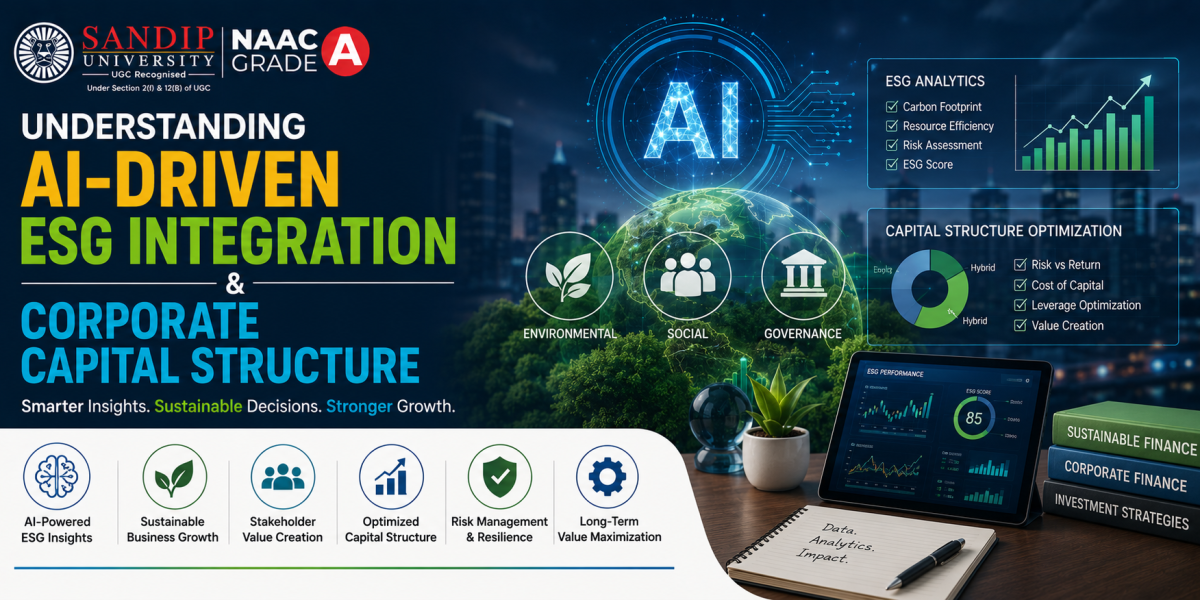
Currently, the world of corporate finance has been significantly impacted by two major forces: sustainability and artificial intelligence (AI). The reality is that the boards of corporations in India are now faced with the expectation that the organisation should not only do well financially but also do well for the environment and society. Thus, the role of ESG and capital structure converges, and the role of AI is revealed as a game changer. Some of the top MBA colleges in Bihar are training students to understand the impact of ESG on corporate governance.
Why ESG Matters for Indian Firms?
ESG has transcended the realm of buzzwords and has become a reality in the corporate world. ESG is a framework that evaluates the organisation’s footprint on:
- Environmental outcomes
- Social responsibilities
- Governance quality
The Securities and Exchange Board of India (SEBI) expects the top 1,000 listed companies based on their market capitalisation to disclose ESG parameters in the Business Responsibility and Sustainability Report (BRSR) in the financial year 2022-23. Sustainability reporting has thus moved from the realm of voluntary rhetoric to one of mandatory compliance.
Nevertheless, its implementation is still challenging for many Indian firms, especially because of heterogeneous data, industry practice variability, and lack of internal ESG analytics. This is what makes it difficult for investors and creditors to assess sustainability performance.
The term capital structure is used to define how a company funds its assets and growth, usually in combination with both debt and equity finance. Decisions about leverage (debt levels), equity issuance, and hybrid financing reflect a company’s risk tolerance, growth prospects, and access to capital markets.
Traditionally, Indian firms tend to rely on bank finance and internal accruals, with a relatively underdeveloped role for corporate bond markets compared to other mature economies. This is still an important feature of Indian corporate finance today, although ESG is increasingly becoming a major factor in determining capital costs and finance options for Indian firms.
Here’s why:
1. Investor Preferences: More and more investors, both institutional and foreign, are preferring ESG factors as a part of their investment decisions. According to the NASSCOM ESG Data Insights Report 2025, “99% of financial institutions surveyed believe ESG data is critical to investment decisions, and 80% of those surveyed incorporate ESG into their decision processes.”
2. Regulatory Incentives: SEBI and the markets regulator are developing sustainable finance markets, including regulations for ESG debt instruments, sustainability-linked bonds, and social bonds, with the aim of developing ESG linked capital options beyond conventional green bonds.
3. Cost of Capital Impacts: Companies that have a higher ESG rating have a reduced cost of debt, more investor trust, and more access to diversified funding sources. This includes sustainable finance funds. Companies with poor ESG ratings may lead to increased perceived risk and reduced access to funding.
Challenges in ESG Measurement and Reporting
Although the significance of ESG measurement is increasing, the results in the context of India have been inconsistent, as the reporting is manual, the metrics differ for different industries, and the qualitative results cannot be compared. At this point, the role of AI and advanced analysis begins.
How AI is Transforming ESG Analytics
The use of artificial intelligence in ESG data management allows for scalability, speed, and pattern recognition. Conventional ESG reporting practices involve the use of manual data collection methods that are time-consuming and often inaccurate. AI is transforming the way ESG reporting is conducted by:
- Handling large volumes of data, including unstructured data such as sustainability reports, regulatory documents, media reports, satellite images, etc.
- Automating the scoring system to help in the easier comparison of ESG performance with peers.
- Making the process more transparent by identifying inconsistencies in the reports.
Academic studies conducted in the country indicate the impact of AI on ESG performance. For instance, an academic paper on the impact of AI on the ESG performance of listed companies in India revealed that the application of AI tools helps improve environmental and governance performance significantly, although the impact on social performance is mixed due to the intricate nature of stakeholder engagement.
Another academic paper on the impact of AI in the high-tech industry in India revealed that AI yields the following benefits for ESG performance: proactive governance, risk management, and stakeholder engagement. Financial institutions worldwide have also utilised AI for ESG analysis. However, challenges still exist.
How AI Enhances Capital Structure Decisions
At a fundamental level, capital structure decisions depend on risk assessment, valuation forecasts, and investor expectations, all areas enriched by low-cost, high-quality data analysis. AI strengthens these decisions in a few key ways:
-
Better Risk Quantification
AI models may incorporate ESG risk into credit risk models. For instance, exposure to the environment, such as carbon intensity, may be quantified and related to future costs of regulation or transition risk. Climate change is changing rapidly in India, and carbon markets are expected to be operational soon.
-
Enhanced Forecasting and Scenario Analysis
AI tools may be used by CFOs and finance teams to forecast how ESG factors may influence earnings, cash flows, and borrowing costs, thus aiding more informed capital budgeting and capital structure decisions. McKinsey’s survey indicates that AI may improve the efficiency of capital allocation by 15%, and project evaluation may be reduced by 20% using AI tools.
-
Access to New Financing Instruments
AI-based ESG scores and Transparency Reports may facilitate the issuance of sustainability-linked bonds or social bonds, which are usually issued with incentives linked to ESG goals being achieved. The Indian market is seeing regulators working hard to create frameworks for such new and exciting products, creating new avenues for finance.
-
State-Level Economic Impacts
The state-level environment also plays a role in research firms. States with robust sustainability ecosystems and infrastructure, such as renewable energy availability or skilled talent pools for green tech, tend to attract firms with stronger ESG ratings. This in turn shapes regional capital flows and industrial investments.
States with favourable environments for technology adoption, such as AI excellence centres, digital innovation funds, or ESG infrastructure incentives, also tend to see greater investments in advanced analytics, leading to a cycle of sustainable growth.
Real World Progress and Obstacles
India is currently witnessing a new environment for ESG. At present Infosys and Larsen & Toubro are using the help of AI to track emissions and make sure that they develop sustainable infrastructure. This is done to boost their ESG ratings in a positive manner. However, there are still some challenges that exist in the ESG environment, and these are:
- Data quality and availability are issues in the ESG environment.
- The adoption of AI is also a problem in the ESG environment.
- Social is the most difficult to measure using AI compared to the other two.
Looking Ahead: Recommendations for India
For the effective adoption of AI in ESG integration, the following are the recommendations that could be made to the Indian context:
- Investing in ESG data frameworks.
- Building AI-ready infrastructure in the Indian context.
- Skill development in sustainability analytics.
- Financial innovation in the Indian context.
Conclusion
Incorporation of AI in the realm of ESG analytics is not merely an improvement in technology but is changing the way Indian corporations approach risk, investments, and capital structures. As investors increasingly factor sustainability into their valuation metrics and regulatory frameworks continue to improve, corporations with better capabilities in the realm of AI-powered ESG analytics are expected to benefit from improved financing conditions, better access to funding, and overall resilience in the long term. Students pursuing MBA from some of the best private universities in Bihar are equipped with the knowledge and skills to understand the impact of ESG on Indian corporations.
In the context of Indian corporations, the path to sustainable finance is one of challenge and opportunity. With the support of AI, the realm of ESG analytics has the potential to improve firm-level capital structures and thereby influence economic competitiveness in the country in the coming decade.