
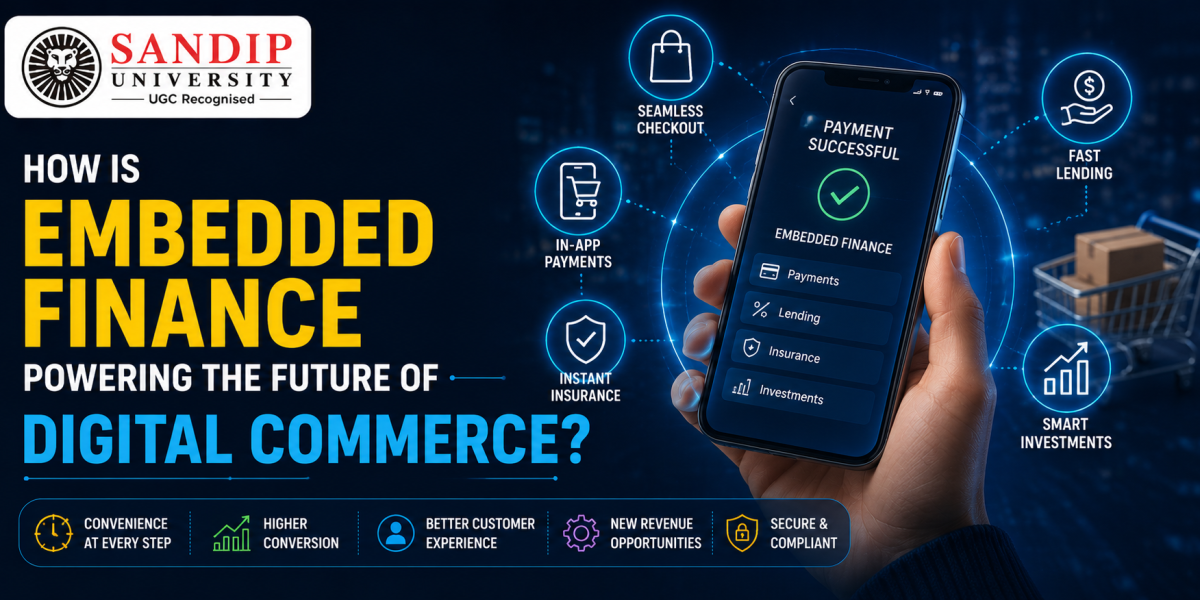
The financial sector is going through one of the most significant changes in its history. For many years, banking services were offered within defined boundaries. Customers went to the bank to create an account, apply for a loan, make transfers, or buy insurance products. Financial institutions acted as central intermediaries that allowed consumers to access any financial service available. But now, all of these boundaries are gradually blurring. Financial services are not only available within banks anymore; rather, they are embedded into everyday digital experiences of consumers. This process is referred to as embedded finance, and it is slowly changing how consumers deal with finances.
The effect is that financial operations have become seamless, and consumers get what they need on time. The revolution in embedded finance is not only about its technical aspect but about the way that it brings a revolution to customers’ expectations. Being in the age of digitalisation, consumers want convenient services, which is why convenience becomes a competitive advantage. With embedded finance, consumers get everything that they desire and more, making it one of the most important inventions of the modern finance sector. Some of the best MBA colleges in Bihar are training students to understand the importance of embedded finance in the future of digital commerce.
The Rise of Embedded Finance
Embedded finance has been greatly influenced by digital platforms’ development and change in consumer behaviour. With the digital transformation of companies from different industries, there was a need to optimise customer journey processes and generate more value. The introduction of financial services became an inevitable step.
Think about the shopping process that takes place on digital platforms nowadays. A consumer buying a laptop does not have to go to another website to arrange finance for it – instalment plans will be available at the checkout. Likewise, a person arranging a flight ticket can get insurance during the process. Moreover, an Uber driver may get instant access to his earnings through a digital bank.
This transformation has become possible through advancements in technology such as Application Programming Interface, cloud computing, and Banking-as-a-Service. This technology is able to create a platform through which financial institutions are able to provide the needed infrastructure to non-financial firms and use it to provide financial services.
Embedded finance appeals to consumers through simplicity because they do not have to move from one platform to another, fill repetitive forms, and wait for a long time to get approval. Financial services are delivered contextually.
Why Embedded Finance Matters
Embedded finance is much more than an emerging technology trend. It signifies a paradigm shift in how financial services are delivered and consumed. In the past, financial institutions have owned their customers. However, digital platforms now own the customer experience with the banks serving the underlying infrastructure.
The advantages for the consumer are quite clear. Embedded finance makes processes easy, time-saving, and accessible. For instance, an entrepreneur using accounting software can apply for working capital financing without even stepping into a bank. An individual browsing on the internet can have his/her credit approved in just a few seconds.
The business sector will experience a lot of benefits from embedded finance because it will help them achieve more profits and also differentiate themselves. The integration of financial services within their services will create an additional source of income for the companies. It will increase the customer experience and also boost customer loyalty.
It will also be advantageous to the financial institutions because they will not only depend on traditional methods of getting customers but also through partnership with digital platforms. This way, the cost of acquiring customers will go down and at the same time reach out to a wider audience.
The Technology Behind the Revolution
Embedded finance relies on advanced technologies for its success. APIs are the main instruments for integration of financial institutions into external systems. Such interfaces provide secure connection that allows enterprises to incorporate payments, lending, management of accounts, and other financial operations within applications.
Cloud computing makes it possible to perform millions of transactions in different market segments thanks to scalable systems that adjust quickly to changes and are safe and reliable at all times. Thanks to this flexibility, the barrier to the entry in the field has been dramatically reduced.
Finally, innovations in open banking contribute to the advancement of the area. As open banking promotes secure exchange of data between financial institutions and trusted third-parties, businesses have more opportunities to create personalised solutions for customers.
Challenges and Risks
However, the application of the idea is not free from complications. For one, integrating financial services into non-financial services brings a number of new aspects in terms of regulation, operation, and safety issues.
Regulation stands out as the greatest challenge. There is a need to adhere to certain regulations due to the nature of financial services. Customer verification, anti-money laundering efforts, data protection, and consumer rights – all these and many other rules should be observed to avoid problems.
Cybersecurity is another key aspect. With financial operations becoming increasingly digitalised, the need to provide adequate protection against cyber threats emerges. Maintaining the integrity and security of customer data involves considerable expenses in terms of encryption and other necessary software and solutions. Building trust is a central issue when it comes to financial services.
Data privacy is yet another major concern. In embedded finance, customer data plays an important role when developing a personalised experience for customers. Even though people tend to appreciate the personalisation and convenience provided, at the same time they have to feel secure about their data.
The Future of Embedded Finance
The prospects for embedded finance are incredibly bright. According to industry experts, embedded financial services will become increasingly popular in almost all areas of business. With the development of technology, financial products will become more personalised, intelligent and embedded in the user’s life.
AI technologies will be crucial in this process. The next stage of finance will involve anticipating needs and making personalised offers depending on the user’s behaviour and preferences. In some cases, financial services will be so deeply embedded in digital ecosystems that users will hardly realise the presence of companies behind them.
It is not just about convenience. Embedded finance will enable better financial inclusion because the financial services will become accessible to those who had difficulty getting access to them before. Embedded finance makes it possible to offer financial services where clients spend time – within digital ecosystems.
Embedded finance is a step from product-oriented banking towards experience-oriented finance. The ability to offer financial products when they are needed and within the context of the right digital experience become decisive for success.
Conclusion
Embedded finance is changing the face of the finance industry through the integration of banking, payment, lending, insurance, and investment services right into everyday digital experiences. What was once an experience that involved multiple engagements with financial organisations can now be accomplished within the same platforms that users interact with on a daily basis? Embedded finance is generating value for both enterprises and consumers, and professionals holding an MBA degree from one of the top BBA colleges in Bihar.
Embedded finance will become an inevitable feature of the digital economy in the years ahead. The companies that take advantage of the embedded finance revolution will not just provide financial services; rather, they will integrate finance right into the experience of their users. Through this process, they will be contributing towards building a world in which finance becomes an intelligent element of every interaction.