
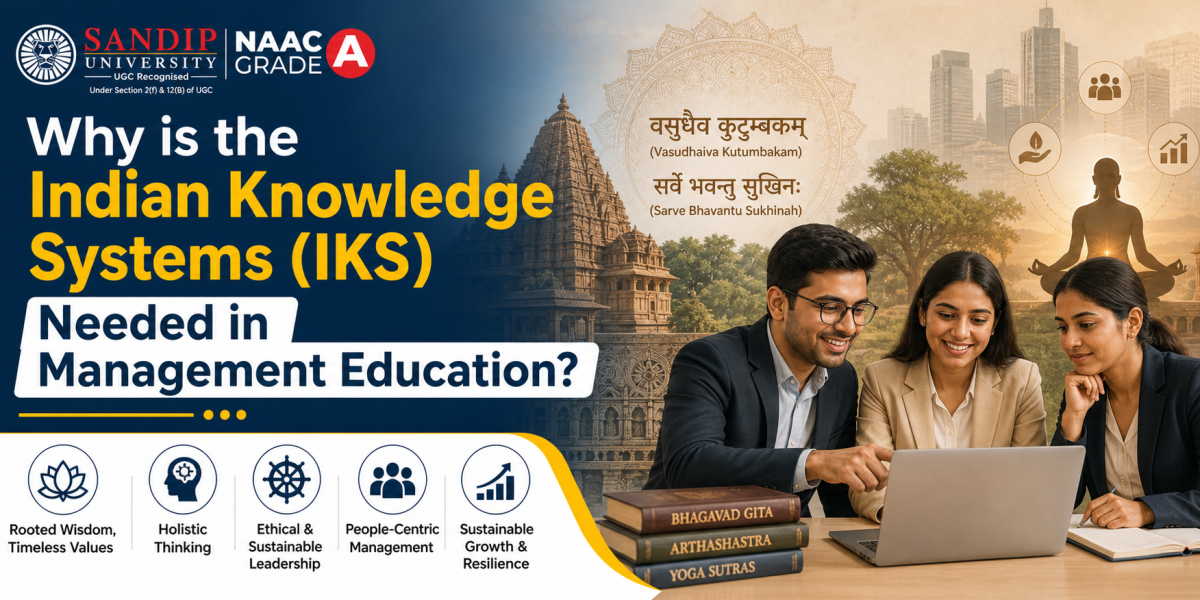
In the fast-changing business landscape of today, management education is experiencing a shift. Though contemporary management theories—heavily shaped by Western viewpoints. They have greatly aided organisational achievement, there is an increasing awareness that they might not adequately reflect the socio-cultural contexts of nations such as India. Here, Indian Knowledge Systems (IKS) arise as a significant and pertinent framework for management departments.
Understanding Management Education in India
Management education in India is changing fast. Instead of sticking to theories of heavy lectures, schools are now focusing more on building real skills, strong values, and teaching what actually works in the world. A big part of this shift is bringing Indian Knowledge Systems (IKS)into the picture drawn by NEP 2020. Drawing from ancient classics like the Arthashastra or the Bhagavad Gita, IKS reminds students that ideas about leadership, ethics, governance, and sustainability aren’t new; they’ve been around for centuries in Indian thought. Today businesses can’t just chase profits but expect companies to act responsibly, care for society, and think about the planet and human well-being which is legislatively documented. With the integration of IKS, management education isn’t just getting more relevant that it has started reconnecting with the deep roots of Indian wisdom, making future leaders better equipped for a complicated world.
Scope of Higher Education in Madhubani
In areas like Madhubani, the change in education system from traditional to professional is apparent via some of the best management colleges in Sijoul like Sandip University, where management education is being tailored to local contexts specially focused on local significance while still keeping global significance.
This method firmly aligns with the objectives of the National Education Policy 2020, which highlights multidisciplinary learning, skill enhancement, experiential education, and the incorporation of indigenous knowledge systems. From a Madhubani viewpoint, management education is becoming a significant instrument for future skill-focused learning and rural advancement just as cultivation of makhana, art, skills etc. It is broadening beyond traditional career routes to incorporate entrepreneurship, digital skills, financial accessibility, and sustainable business methods.
Students are urged to investigate nearby opportunities like Mithila art, agricultural ventures, and cooperative frameworks, encouraged to foster self-sufficiency and local economic development by local resources. Simultaneously, the involvement of digital resources, development of online commerce culture, and financial technologies is equipping them for involvement in the contemporary economy.
The integration of IKS enhances leadership traits by highlighting ethics, emotional intelligence, mindfulness, and a focus on community. At Sandip University, these concepts are manifested through hands-on projects done by students under the mentorship of faculty, extension activities done by school with local organisations to understand the potential of the market, skills training workshops, and ethics-focused learning modules, guaranteeing that students acquire both theoretical understanding and practical experience. This comprehensive method not only boosts employability but also inspires students to become job creators and socially accountable leaders.
Conclusion
To sum up, involvement of Indian Knowledge Systems into management education is not just an academic advancement but a strategic enhancement for inclusive and sustainable growth to the nation. Following the National Education Policy 2020, some of the best NAAC-accredited universities in Bihar like Sandip University are practically doing ground level work in a renewed educational era by integrating tradition with innovation, knowledge with practical skills, and local resources with global significance. This change has the ability to empower youth, help in boosting rural economies, and cultivate a generation of leaders who are efficient, innovative, ethical, and socially aware.
Explore management programs at Sandip University that combine modern education with Indian Knowledge Systems for future-ready leadership.