
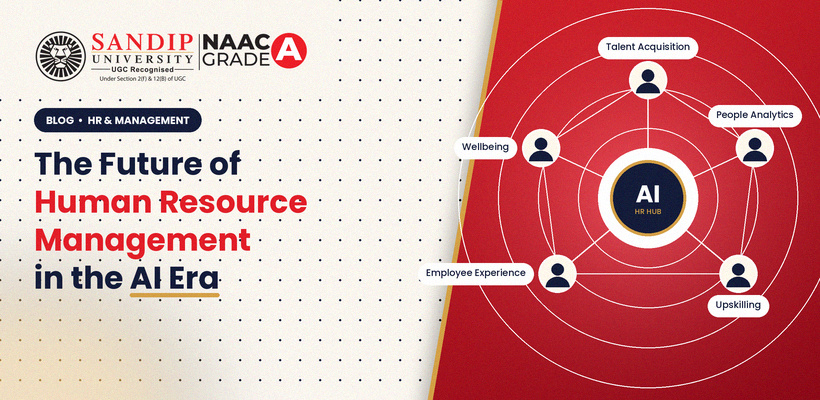
The operations in the contemporary world are quite different from what used to happen in the past. Technological interventions have touched many aspects of our professional lives, and HRM is no exception. In the past, HR managers from some of the top BBA colleges in Bihar used to focus on recruiting employees, keeping a record of their attendance and salary, etc. However, nowadays, HR has become one of the most significant pillars of organisational growth because companies realise that managing people is as important as managing money.
In the age of Artificial Intelligence (AI), organisations are using digital technologies to speed up work and make it more efficient. Digital recruitment processes, online interviews, and digital monitoring of employees’ performance are being used widely. This evolution has changed the role of HR professionals and created a whole new culture of work. At present times, companies look for those who can adapt easily, blend into organisational dynamics, and build organisations.
Nevertheless, regardless of any kind of development in technology, one thing always stays the same – organisations thrive because of people.
AI is changing HR, but it cannot replace human understanding
Artificial Intelligence has certainly revolutionised the field of HR. Currently, many businesses use computers to filter out resumes, find the right candidate, and analyse employee data. AI has the potential to help in saving time, eliminating repetitive tasks, and increasing efficiency in multiple functions of Human Resource Management.
However, there are some things that technology is unable to do. While a machine may be used to select the right candidate for the job, it cannot feel emotions, behaviour, relations at work, or problems of the person. A machine is not capable of empathy, trust, motivation, or emotional connection. These aspects are comprehensible to human beings only.
Therefore, the future of Human Resource Management is not in the hands of just those individuals who are aware of the technology. The future of human resource management lies with the individuals who can combine technology with the human values.
In today’s world, the HR managers have to be capable of communicating with the employees, solving their problems, motivating them, and creating a good atmosphere at work. Technical skills are needed but the emotional quotient is also required. Very often people do not remember company policies but they remember the way they were treated.
Skills Required By Students for the Future
The corporate world is changing at a very rapid pace and the future managers have to gear up for the new requirements. In the olden times, education used to be the only thing that could help an individual secure good career options. However, nowadays, there are other things that organisations expect from the youth.
Today’s employers look out for individuals who can communicate confidently, can solve problems analytically, can work in teams and can adapt to change. Creativity, leadership, analytical skills and interpersonal skills have become very important.
This quotation very precisely reflects the essence of Human Resource Management. The essence of HR lies not in management of documents and policies of HR, but in management of people. There are cases when an employee does not voice his or her stresses, dissatisfactions and complaints, but the good HR manager can feel them.
The human element in Human Resource Management makes the career interesting and valuable. That is why those students who get ready for the career in HR have to pay attention not only to theoretical aspects of their work but also to personal qualities.
Preparing Students for the Future at Sandip University
At Sandip University, the School of Commerce and Management Studies is one of the top MBA colleges in Bihar. It is making efforts to prepare students for the practical environment of the present-day workplace. In addition to imparting academic knowledge, an effort is made to provide practical experience and personality development to the students.
Workshops, presentations, seminars, group discussions, industry interaction programs, and class discussions enable students to gain improved skills in communication, leadership, and professionalism. Through this, students get practical insights into the application of management principles, for students coming from Bihar and Mithila, such chances prove to be invaluable. There are many students who have all these qualities and are determined, but require some more exposure to the industrial requirements. Practical institutes provide an ideal opportunity to make up for such a deficiency among the students.
In the current context, management education does not merely pertain to the acquisition of a degree but also the development of the required confidence and professionalism.
The Wellbeing of Employees Is Gaining Great Importance
Another important trend in HRM today is the emphasis put on the wellbeing of employees. Until now, productivity and profitability were the two main things that mattered to companies. Nowadays, it has become clear that people tend to be much more efficient when they feel respected and healthy.
Work-related stress, burnout, and emotional pressure are the major problems that occur in different spheres. This means that the duties of an HR manager comprise ensuring a good atmosphere at work.
Employees are not machines. Employees are human beings who have emotions, who have personal problems, responsibilities and ambitions. A workplace which realises this fact will become a more productive and positive one.
The Emergence of Hybrid & Remote Work Culture
Workplace has been changed significantly after the emergence of the hybrid and remote work culture. Now employees are working from other cities or even from other countries but are still connected via digital means.
Even though technologies have made communication between people much easier, there appeared another challenge – managing people remotely. In today’s world, HR managers need to ensure that employees are engaged, collaborative, trusting one another, and connected to the organisation regardless of the distance separating them.
This is why tomorrow’s workplace requires HR managers who are not just technologically savvy but emotionally intelligent as well.
Conclusion: The Future belongs to the Human-centered Leaders
As different industries proceed to automation and digitalisation, the significance of human values is becoming even higher. While technologies will streamline different procedures, empathy, honesty, kindness, leadership, and communication skills will always be necessary for any organisation.
Good HR managers holding an MBA in Human Resource Management can help companies recruit employees, while great HR managers will be able to develop employees and help them feel valuable and self-confident.
The future labor market will require leaders who are not only strategic thinkers but also capable of understanding human feelings and relationships. This is the reason why management students should prepare themselves not only for technical knowledge but also for their emotional and ethical skills.
The future HRM will be the domain not of software and technologies, but of individuals who know how to keep humanity alive in contemporary organisations.
Frequently Asked Questions (FAQs)
What is the future of HRM in the AI era?”
The future of HRM will combine artificial intelligence and digital technologies with human skills such as empathy, communication, leadership, emotional intelligence, ethical decision-making and adaptability.
What skills will HR managers need in the future?”
Future HR managers will need a combination of technical and human skills, including communication, analytical thinking, leadership, creativity, adaptability, teamwork and emotional intelligence.
Why is emotional intelligence important in HRM?
Emotional intelligence helps HR professionals understand employees, communicate effectively, address workplace concerns, build trust and create a positive organisational environment.
How is AI changing Human Resource Management?”
AI is changing HRM by supporting activities such as resume screening, recruitment, employee data analysis and other repetitive processes, allowing HR professionals to focus more on people and organisational development.